In the real estate sector, the golden rule is repeated over and over again: "Location, location, location." This principle remains important, but its meaning has changed significantly in recent years. A good location no longer means solely proximity to the city centre or being situated next to a symbolic central point of a city.
Nowadays, people increasingly value the living environment a region offers—how nature, everyday services, mobility options, and community space work together in synergy. Just as it is possible to create a personalized and cozy home from an empty apartment based on a well-thought-out project, a seemingly ordinary area can also be shaped into a valuable habitat if it is developed holistically.
Empty land is not worthless
The experience of many developments shows that a new, vibrant environment can also be created in places that at first glance lack a strong urban identity. However, this does not happen by itself. It requires meaningful cooperation between city planners, architects, developers, and builders.
The "field developments" that emerged during Estonia’s first real estate boom—which faced largely justified criticism—are now a thing of the past. These were often hastily planned residential areas where buildings were erected, but the broader living environment was neglected: proper infrastructure, green spaces, and community-building spaces were missing.
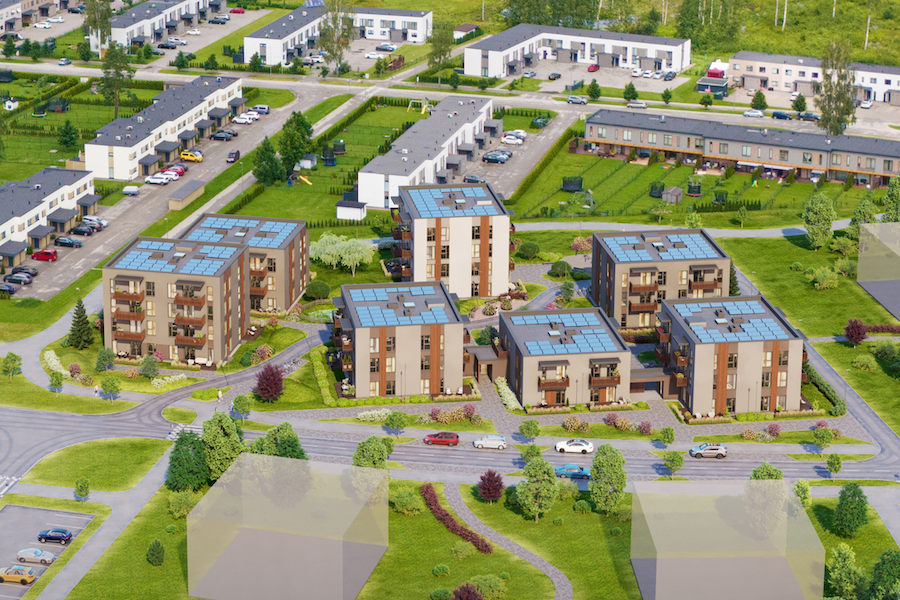
Today, the approach is different. When undeveloped areas are being built up, developers strive to create well-thought-out quarters where attention is paid to the entire living environment: convenient transport links are planned, kindergartens and schools remain within reach, and green spaces and recreational opportunities are part of the initial concept, not a later addition. A developer's task is no longer just to put up buildings, but to shape a complete place where it is good to live.
Placemaking gives an area an identity
In the vocabulary of city planners, urbanists, and architects, the term "placemaking" is increasingly used. It is a purposeful process through which an anonymous piece of land or plaza is given an identity, value, and character. Of course, capturing the spirit of a place is relatively easy in an area with a strong historical background—for example, when revitalizing an old port area, a riverbank, or adjacent to a functioning cultural hub. There, the existing environment dictates, as it were, which values to bring forward.
A much greater challenge is creating a meaningful living environment in a completely new location. However, no place is actually ever completely empty. If you look beyond the boundaries of the development area, you can always find connections—be they historical, cultural, or natural—on which the identity of a new area can be built.
A great example is the development of the Raadi area near Tartu, where the history of the old military airfield, the cultural value of the Estonian National Museum, and the proximity to the city of Tartu have created a living environment with a strong identity. Raadi shows well how a valuable new location can take shape over time. The same principle is carried by the Raadi Roosipargi residential quarter rising in the area, where they are not merely creating new homes, but a complete living environment—connecting an area with a historical and natural background with green spaces, well-thought-out spatial solutions, and opportunities for community life.
From a buzzword to real value
The term "campus" or "micro-district" (linnak) used by developers may sometimes sound like a marketing buzzword, but in meaningful projects, there is real and tangible work behind it. It means creating an environment where buildings, public space, nature, and people's daily needs form a unified whole.
Since today's quality residential areas are not always located in the physical heart of the city, good connections, proximity to services, and the opportunity to live in balance with both the urban environment and nature become particularly important. Well-thought-out new developments in constructed micro-districts also make quality homes more accessible, for example, to young families or those purchasing their very first home. It is precisely they who bring actual life to the new areas by using parks, playgrounds, and public spaces, and shaping a functioning community over time.
A location is what you make of it
The golden rule of real estate development regarding location has not disappeared, but its content has changed over time. Today, people are not just buying square meters or a location on a map, but a complete living environment, a community, and a lifestyle. The best developments understand this and work to give a new place meaning even before the first resident moves in. In this way, a seemingly empty plot can, over time, turn into a place where people genuinely want to belong.
Opinion piece published on the Tartu Postimees portal.